


# Hotel Full Wireless Network Solution (100-200 Rooms)
## Scenario Overview
Targeting medium-sized business or resort hotels with 100-200 guest rooms, this solution provides an integrated network architecture centered on a high-performance switching network and full wireless AP coverage. Through a stable and efficient two-tier network structure, it focuses on delivering reliable power supply, access, and management for a large number of wireless APs, ensuring guests enjoy a smooth, secure, and seamless internet experience across all scenarios such as guest rooms, lobbies, and meeting rooms.
## Requirement Analysis
- **Dense Wireless Terminal Access**: During peak hours, it needs to stably support concurrent access of 300-600 wireless terminals (mobile phones, tablets, laptops), which imposes requirements on the uplink switch port density and forwarding performance of wireless APs.
- **Full Wireless Service Bearing**: The network must reliably carry traffic from guests' Wi-Fi, hotel operation Wi-Fi (PMS mobile terminals, intelligent guest control), and wireless security devices (such as wireless cameras) simultaneously.
## Network Architecture Design
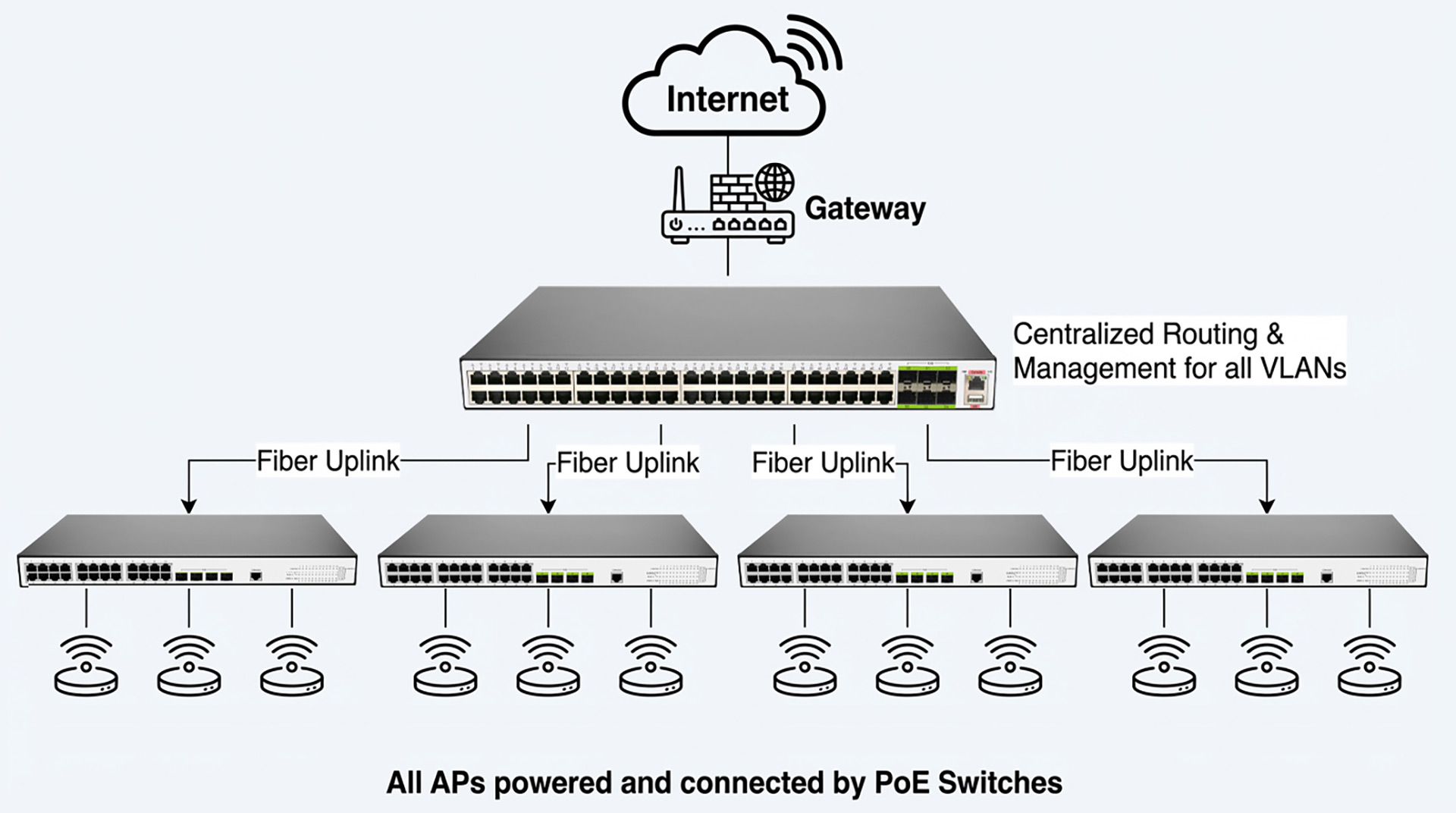
Adopt a streamlined two-tier "Core-Access" architecture. All service traffic and policies are uniformly processed by the core switch, while access switches focus on providing high-density, high-performance AP access and power supply.
### Core Switching Layer
Deploy 1-2 high-performance gigabit managed switches. As the sole core and "brain" of the network, it is responsible for:
- Routing intercommunication between the management VLAN of all wireless APs, guest data VLAN, and hotel operation VLAN.
- Deploying a DHCP server to assign IP addresses to APs and wireless terminals.
- Implementing basic guest network isolation policies through ACL or firewall modules.
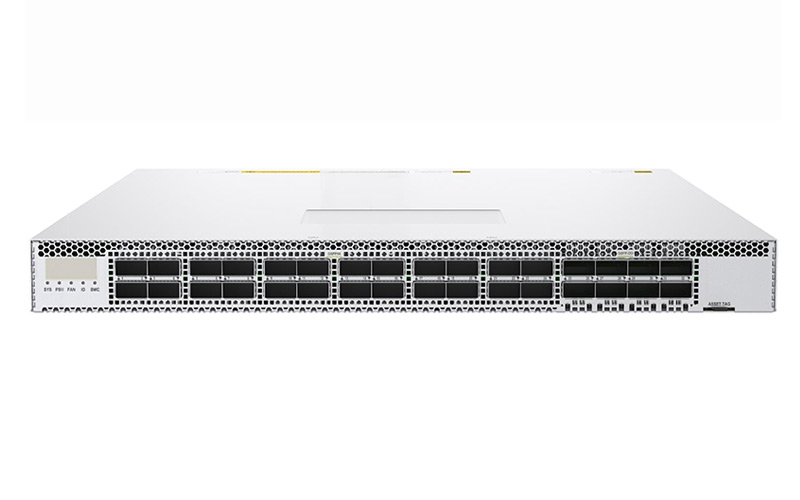
- Uplinking to the egress router/firewall via 10G optical ports.
### PoE Access Layer
Deploy multiple gigabit PoE+ switches by floor or area:
- Each access switch uplinks to the core switch via gigabit or 10G fiber optic links.
- All downlink electrical ports of the switch provide 802.3at/af PoE++ power supply and gigabit data transmission for wireless APs deployed in the local area.
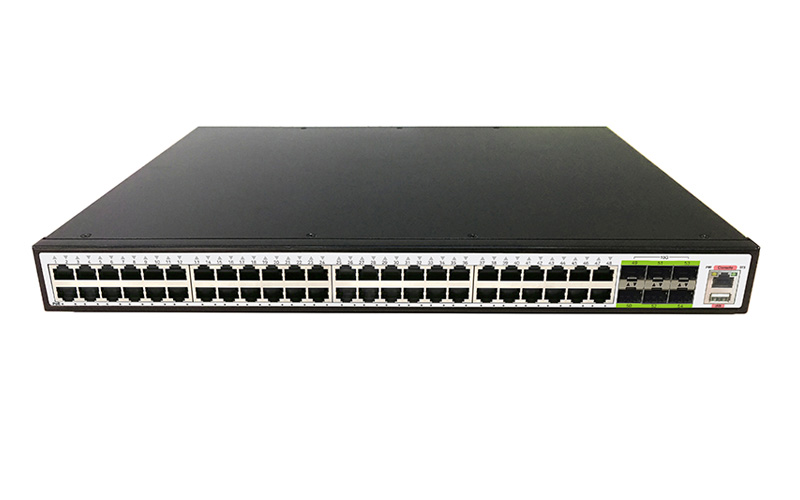
- Depending on the number of APs, 24-port or 48-port models can be selected, with some ports reserved for expansion or connecting local devices (such as floor security cameras).
### Wireless Coverage Layer
Wireless APs serve as pure access terminals, directly connected to the PoE ports of switches via network cables, and are configured and managed by an independent Wireless Controller (AC).
## Topology Diagram
## Recommended Device Specifications
## Solution Advantages
- **Streamlined Architecture with High Stability and Reliability**: The two-tier network architecture greatly simplifies wiring and management logic, reducing potential failure points. Access switches focus on power supply and access, while the core switch specializes in routing and policies, with each performing its own duties to ensure high stability.
- **Robust AP Infrastructure Centered on Switches**: Professional PoE+ switches offer far superior power supply stability and port load capacity compared to ordinary switches, ensuring all APs operate stably 24/7. This eliminates random AP disconnections caused by unstable power supply, laying the physical foundation for a high-quality wireless experience.
- **Intuitive Operation and Maintenance with Easy Fault Location**: Through the unified management of the core switch and port status monitoring of access switches, operation and maintenance personnel can clearly view the connection status, traffic, and power supply of any AP. When an AP is offline, it is easy to quickly determine whether the issue lies with the switch port, network cable, or the AP itself, significantly improving troubleshooting efficiency.
- **Flexible Deployment and Easy Scalability**: The access switch for each floor or area functions as an independent module. Adding new floors or expanding coverage only requires adding corresponding PoE switches and uplinking them to the core, enabling rapid scalability and protecting initial investments.




TOP

 (+86)13692163603
 sales@hodonet.com
 Facebook
 Linkedin
 Youtube
 Tiktok